I. From Words to Clay: A Young Man Searching for Expression
Li Jinghuan initially didn’t intend to become a ceramic artist. In his early twenties, he published his first book—those clumsy, rough words were his attempt to answer a simple question using writing, his “first language”: How should I express myself?
Starting with words, he dabbled in modeling and painting, transforming the emotions swirling in his mind into visual forms. Writing, film, and the body—these three mediums ultimately pointed in the same direction: the exploration of “form.” And ceramics, precisely, became the most three-dimensional container for this exploration. Clay became a vessel for his emotions, and also an extension of his thoughts.
Today, people often call him a “content creator,” but he feels that this boundary has long been blurred. Chefs, writers, carpenters, even restaurant owners are all turning their work into content sharing—he just stepped into this trend earlier than most. What truly solidified his choice of ceramics was that moment of “unparalleled joy when touching the clay.” When fully immersed in creation and hearing these moments resonate positively with others, the work acquires a deeper meaning.
II. The Allure of Pottery: Finding Certainty in Uncertainty
For Li Jinghuan, the greatest attraction of pottery lies in witnessing firsthand the process of a piece coming to life. This process is full of variables: the texture of the clay, the thickness of the glaze, the temperature and humidity inside the kiln—even repeating the same steps can yield drastically different results. It is precisely this uncertainty that makes pottery so captivating.
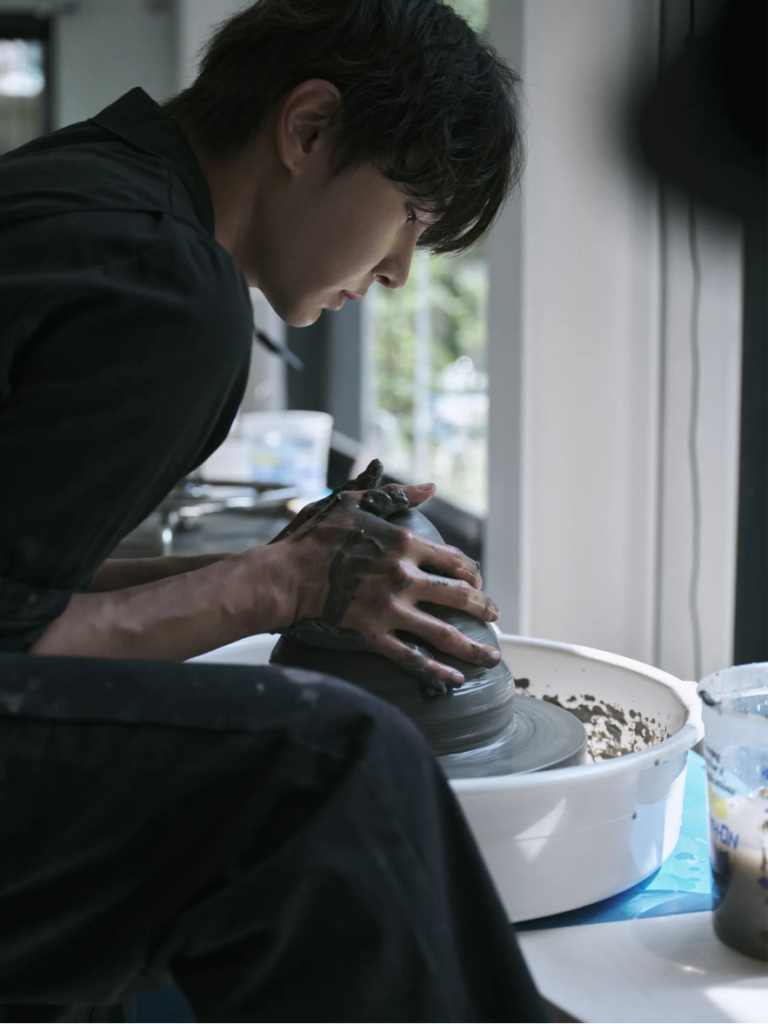
More importantly, pottery has transformed his state of mind and body. Adults rarely have the opportunity to touch unrefined clay. Sitting before the potter’s wheel, placing the clay at its center, external anxieties and pressures gradually dissipate. At that moment, one no longer calculates the outcome but begins to feel with the heart. For him, pottery is not merely a creative act, but a complete experience that mobilizes emotions, body, and mind.
III. “Imperfection is Okay”: A Creative Philosophy Against Perfection
Li Jinghuan hopes to convey a concept through his works: imperfection is okay. He doesn’t believe there are standard answers in art—the same piece might be beautiful to one person but bland to another. A slightly distorted shape might evoke a warmer feeling, and a glaze softer than expected could still possess a unique beauty.
This philosophy naturally extends to his video content. While the finished product is always paramount, he believes the creative process and the attitude behind it are equally meaningful. If a work can temporarily relieve the pressure of searching for the “right answer,” then it has achieved its purpose.
IV. Throwing and Life: Patience is More Important than Skill
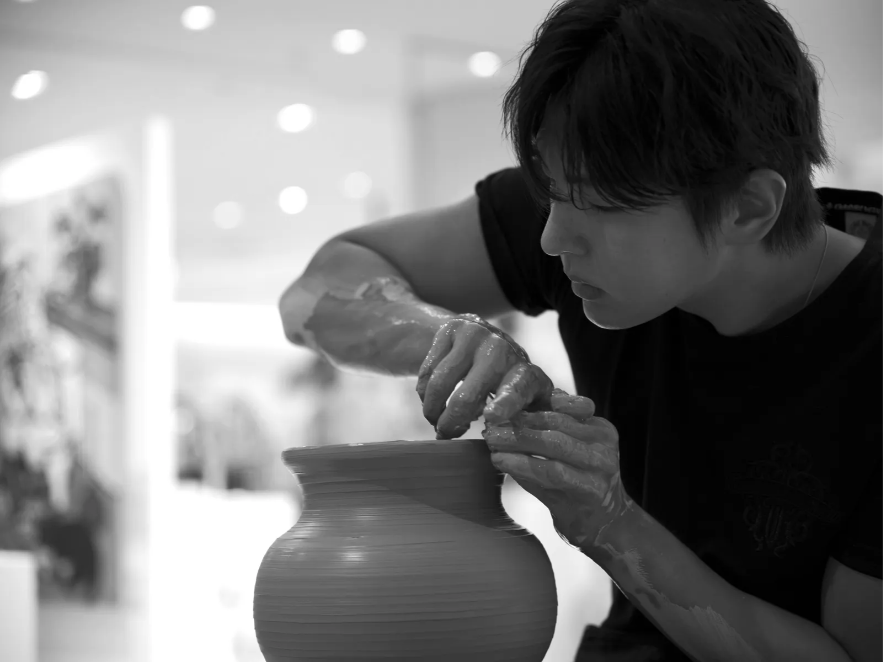
In throwing, Li Jinghuan gradually realized that patience is far more important than skill. Completing the clay body doesn’t mean the work is finished—the final effect can vary greatly depending on kiln temperature, humidity, or the condition of the clay. The more one strives for perfection, the more patience is required in the process.
“Through throwing, I often feel like I’m learning about life,” he says. Technical precision doesn’t guarantee a good result; what’s more important is unwavering dedication from beginning to end, maintaining focus and meticulousness. In this process, he also gains a clearer understanding of himself.
Skills can improve over time, but mindset must be adjusted daily. For him, throwing on a potter’s wheel is less about mastering a skill and more about returning to himself.
V. Taipei Memories: The Kindness of Strangers and a Pottery Studio
In 2025, Li Jinghuan visited Taipei and stayed in the Zhongshan District. He participated in an environmental project, transforming collected waste into art. While cleaning the streets, he was deeply moved by the spontaneous enthusiasm of the local residents—people, even strangers, worked together to protect shared spaces.
During that trip, he also visited a pottery studio. At the time, he was preparing to establish his own studio in Seoul, and the carefully designed space of this studio gave him a deeper understanding of the importance of the environment to creation. He still remembers the friendliness and enthusiasm of the people he met, and is therefore sincerely happy to return to Taiwan.
VI. On Teaching: Reconnecting with the Essence of Creation
In the “Clay Studio: Pottery Throwing Workshop” at Vogue Wellness Week 2026, Lee Ching-huan didn’t expect students to create perfect works or fully master techniques in a short time. The focus wasn’t on technical proficiency, but on experiencing the joy of touching clay and creating by hand.
“Sitting in front of the potter’s wheel, letting go of distractions, focusing on the feeling and the movement—even a brief immersion can be meaningful,” he said. If students leave realizing that creating by hand is valuable in itself, that’s enough. This workshop is less about completing a piece and more about reconnecting with the essence of creation.
VII. A Ceramic Artist in the Social Media Age: Between Popularity and Original Intention
Lee Ching-huan’s Instagram followers have surpassed 1.4 million, and his Reels video has reached a peak of 20 million views. Social media has made him known across borders and facilitated a collaboration with Vogue Taiwan. But he doesn’t blindly chase trends.
“I hope to dedicate myself to ceramic art long-term,” he said. Social media serves as a bridge, allowing his work and perspectives to reach a global audience. However, he also notes that many artists today spend as much time thinking about how to communicate their work as they create it—this is the real challenge facing contemporary artists.
He is unfazed by negative feedback: not everyone will resonate with his work in the same way. As long as he remains honest in expressing his creative intentions, he won’t be overly swayed by external judgments.
VIII. The Tension Between Two Identities: Content Creator and Artist
There is indeed a tension between content creators and artists: the former is outward-facing and driven by rapid feedback; the latter begins with introspection and unfolds slowly over time. But both ultimately answer the same question: how to transform inner feelings into something others can also experience?
Excessive focus on external reactions, like complete self-isolation, limits development. In a fast-paced environment, maintaining a balance between oneself and the world is crucial. These two roles are not opposing forces, but rather a constant reminder of how to stay grounded.
IX. A “Failed” but Viral Success: Fragility is More Sincere than Perfection
He had a highly popular Reels video where he accidentally ruined his pottery piece at the end. At the time, he thought the video was a complete failure—the filming process was choppy, and the effect didn’t meet his expectations. But when he released the “failed version” exactly as it was, many people resonated with it on a deeper level.
“Fragility and imperfection sometimes reveal more sincerity than perfection.” He realized that this is an era where people value process more than perfection—the unfinished edge of a work and the existence of the person contain a deeper meaning.
X. The Birth of a Book: The Time That Shapes Me
In an era dominated by social media, Li Jinghuan chose to publish a physical book, The Time That Shapes Me. The reason is simple: in the digital space, anyone can easily project a perfect image, and everything operates at an astonishing speed. He, however, is someone who needs to be hands-on and use his senses—a physical book can be held in one’s hands, carefully read, and slowly savored, which perfectly aligned with his initial intention.
The book’s central theme is simple: life is a cycle. Success is not eternal, and adversity will eventually pass. What matters is not the outcome, but the attitude—humbly moving forward in good times, and seeking meaning in adversity. He hopes this book can offer a moment of companionship to those who prefer to move at their own pace, or those seeking meaning in life during moments of confusion.
Li Jinghuan’s story is essentially a story about “slowness.” In an era that pursues instant gratification, he chose a lifestyle that requires waiting, patience, and acceptance of uncertainty. The soil doesn’t lie, time doesn’t flow backward, and the moment a person sits facing the potter’s wheel is perhaps the rarest tranquility in this era.